Anatomy of a Web Request
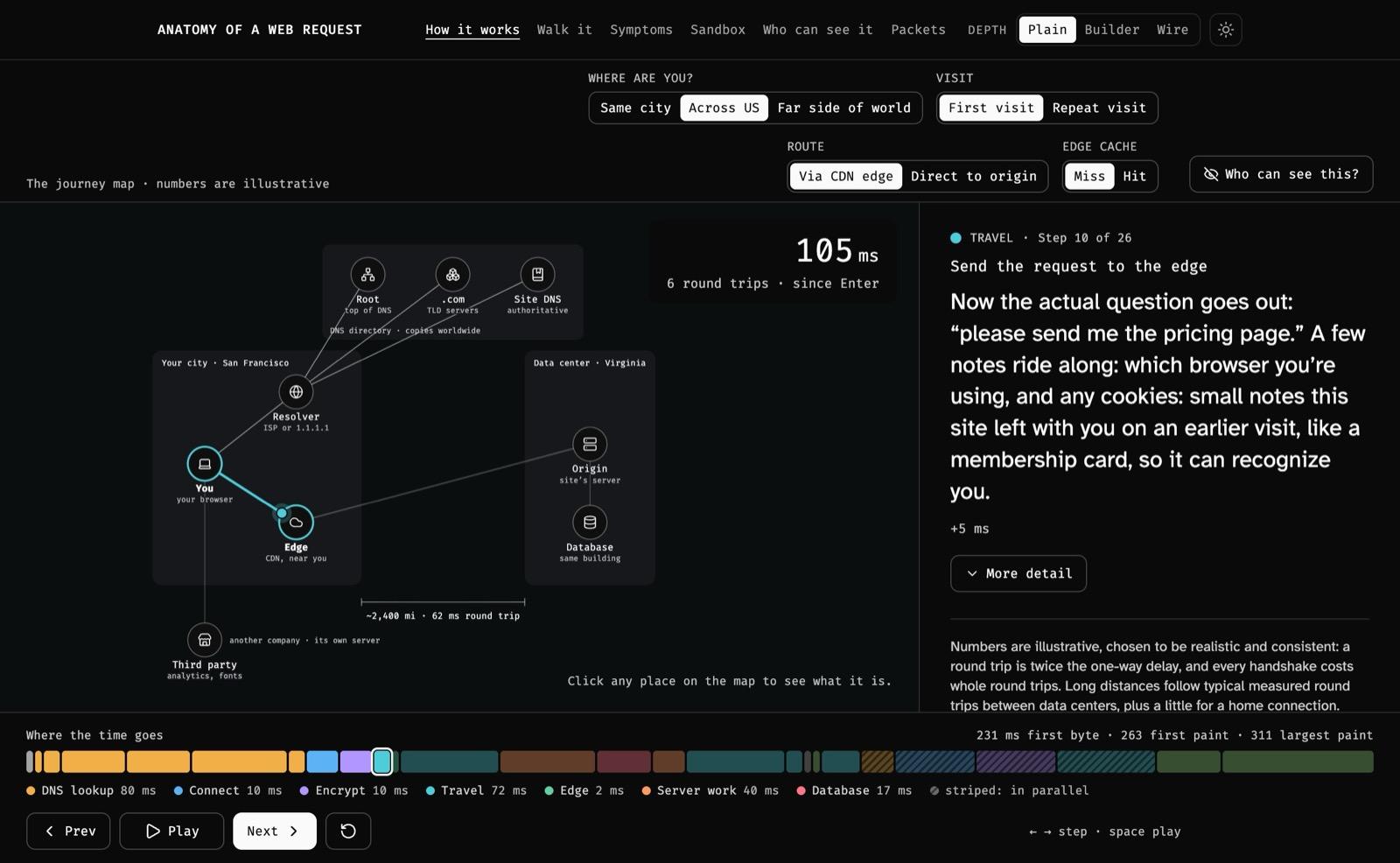
An interactive walk through one web request: DNS, TLS, the CDN, the server, the data, and where the time goes. I wanted a way to show what happens between typing a URL and seeing a page, one phase at a time.
Why I built it
I wanted something I could pull up live and show people: what happens between typing a URL and seeing a page, at the level a working developer needs. What a cache hit does to the rest of the trip, what Cloudflare is actually doing, why Let's Encrypt works, and how an AI agent's request differs from a browser's.
What I learned
- Accuracy is the hard part, and the mistakes are subtle. My HTTP step opened with
GET /pricing HTTP/2. That's HTTP/1.1's text framing; HTTP/2 and 3 are binary. Fixing it properly turned into a toggle between 1.1, 2, and 3. - Round trips are easy to miscount. Five examples bundled TCP and TLS into one step at the edge and counted it as one round trip. It's two: TCP, then TLS 1.3. A nearby edge makes each trip faster, and the count stays at two.
- Hardcoded facts rot. The DNS step showed example.com's IP address, which changed around 2025. Now it says "an A record" and has nothing to go stale. Certificate lifetimes moved too: 90 days read as current, and Let's Encrypt now issues 6-day certificates. One SEO blog claimed the LCP threshold dropped to 2.0 s in March 2026. web.dev still says 2.5 s.
- Caching doesn't fit on a timeline. It happens in the browser, at the edge, in a page cache, in the app, and in the database. It became a concept you can open from anywhere, with a cold and a warm version to compare.
How to help
- If you work on networking, CDNs, or browsers, tell me what's wrong. Accuracy is the point, and the deepest open review items are TLS wording and edge/CDN claims.
- If you teach or onboard people, use it in a session and tell me where they got lost.
- Suggest a real stack for the examples. It covers Craft on a VPS, Next.js on Vercel, Payload in Next.js and headless, a load balancer, and Kubernetes.
The millisecond figures are illustrative for a US visitor hitting a US origin. If you have measured numbers that tell a different story, send them.
Keep in touch
Questions, ideas, or something broke? Email me. For updates on this and whatever I build next, get the newsletter.