To explain something · To learn something
Harbor Master
Kubernetes explained by letting you break things. Crash a copy of a website, unplug a machine, flood it with traffic, ship a buggy release, and watch the site keep running. Written for sales, designers and business owners, with a developer view underneath.
Why I built it
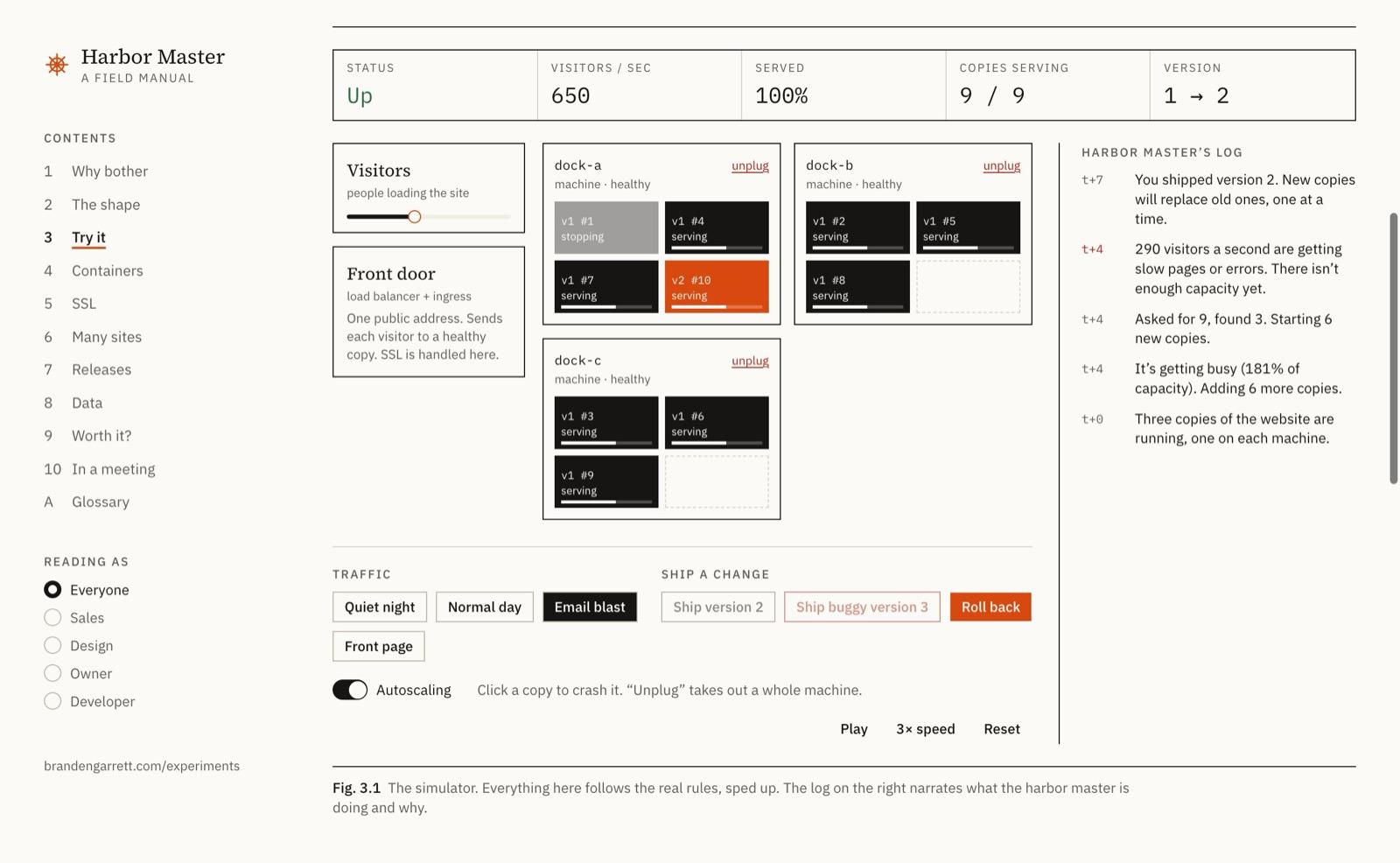
We host Payload and Craft sites on Kubernetes, and I wanted the people I work with (sales, designers, the owner's chair) to understand what that buys a client and what it doesn't. "It's on Kubernetes" means nothing until you've watched a machine die and the site shrug it off. I wanted something they could poke at in a meeting, where the request, the copies, the database and the certificate are all things you can see.
What I learned
- The website heals; the data doesn't. Every trick here works because copies of a site are disposable. The database and uploaded files aren't, and what protects them is backups and someone who tests the restores.
- Uploads decide your deploy strategy. If uploads live on a disk only one machine can attach, you can't safely run old and new copies side by side, so you're stuck with Recreate deploys and a short outage on every release. Moving files to shared storage is what unlocks zero-downtime rolling updates.
- A health check only catches what it checks. A release that can't boot never gets visitors. A release with a broken layout passes every check and goes live, which is why rollback has to stay a few minutes away.
- "Self-healing" has a clock. A dead machine is noticed in under a minute, but by default its copies aren't rebuilt elsewhere for about five. The site stays up because the other copies carry the traffic in the meantime.
- The ground moves under you. While I built this, the community ingress-nginx controller, once the default almost everywhere, had already been retired (March 2026), and Let's Encrypt announced certificates dropping from 90 days to 64 in 2027 and 45 in 2028. Running a cluster means keeping up, forever.
How to help
- If you run Kubernetes, tell me where a simplification turned into something wrong. The simulator is sped up on purpose; the behavior shouldn't be.
- If you sell or design websites, use it in a meeting and tell me where people got lost, or which line you wished you could say.
- If you'd explain one of these layers differently, send me the analogy. The harbor is doing a lot of work.
Keep in touch
Questions, ideas, or something broke? Email me. For updates on this and whatever I build next, get the newsletter.