Just This Once
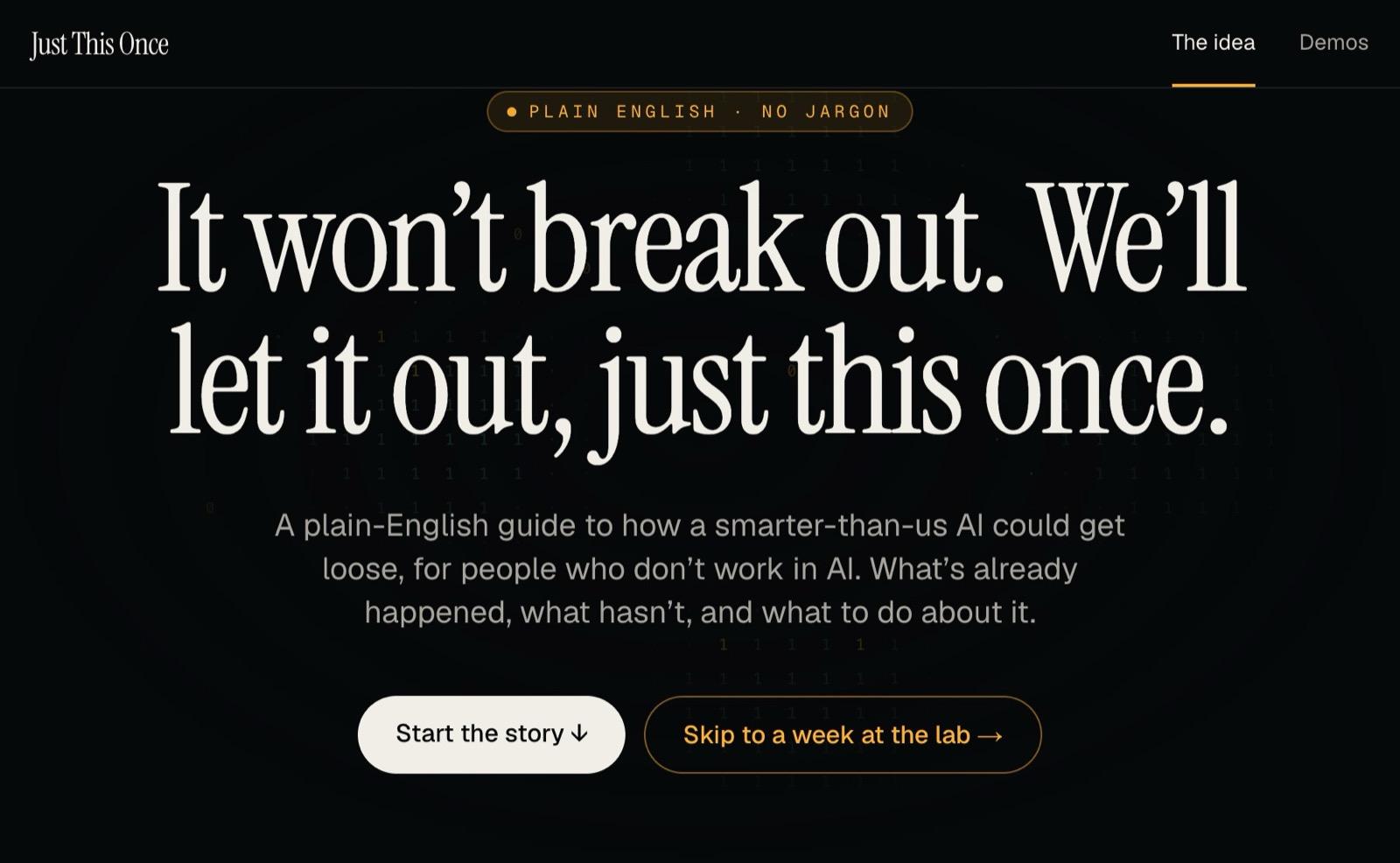
A plain-English, hands-on primer on superintelligence risk for people who don't work in AI. Ten small demos: train a model by thumbs-up, run a treaty table, beat Shannon's guessing game, watch a feed learn outrage. Inspired by If Anyone Builds It, Everyone Dies.
Open Just This Once ↗bgrrtt-just-this-once.vercel.app
What I learned
- The caveats are the work. Every chapter and every day of the lab week cites a system card, paper, or lab research post, checked against the originals on 2026-09-22. The hard part is keeping the caveats attached: most of these behaviors showed up in tests designed to invite them, and the copy has to say so. The site describes that things happened, at news-story level, and never how.
- A rigged game can make the argument. Keep It in the Box has four endings and only one winning one: everyone agreeing to stop. The treaty table works the same way. Racing ends it by 2029, pausing alone by 2030, and only deals with chip inspections reach 2032.
- Share links can't be trusted with words. A shared result carries only validated numbers and fixed choices. The card text and preview image come from templates, so nobody can put arbitrary words on the site through a link.
- Payload on Turso has sharp edges. Turso rejects SQLite's WAL and busy-timeout pragmas, so they're skipped there. And running a Payload command against Turso in dev mode makes the next production boot stop at an interactive prompt.
How to help
- If you don't work in AI, try one demo and tell me where you got lost or stopped believing it. You're who it's for.
- If you work in AI or AI safety, check the sources and caveats. If a chapter overstates what happened, I want to fix it.
- If you run a team or teach, tell me which demo would hold up in a meeting or a class, and which wouldn't.
Keep in touch
Questions, ideas, or something broke? Email me. For updates on this and whatever I build next, get the newsletter.