To explain something · To learn something
Two Keys
A hands-on guide to public and private keys. Make a key pair, lock a message, forge a signature and watch it fail, then see how SSH and Meshtastic radios use the same idea.
Why I built it
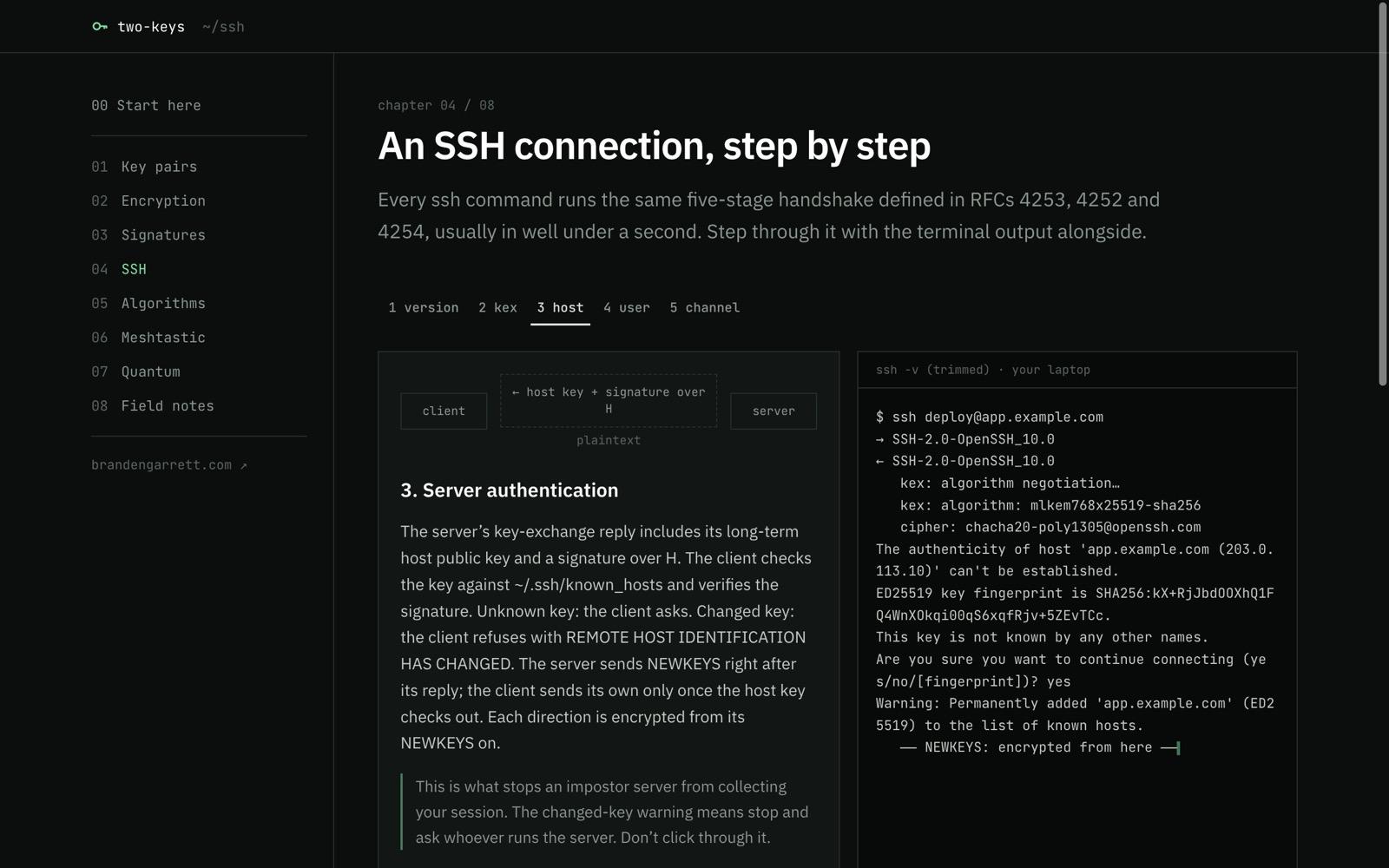
Two reasons. I wanted a way to explain SSH to the account managers and project managers I work with, so when I say "this is how we get code onto a server securely" they can picture what's actually happening. And I just got into Meshtastic, the cheap LoRa radios that text each other with no cell service. Every radio hears every message, so a direct message only stays private because of public and private keys. I wanted to understand that properly instead of trusting it.
What I learned
- RSA isn't broken. I went in thinking it was. NIST rates a 2048-bit RSA key at 112-bit security, and its final post-quantum plan (October 2026) deprecates RSA and elliptic curves alike after 2030, at every key size. What OpenSSH retired in 2021 was the old
ssh-rsasignature, which used SHA-1. People moved to Ed25519 because it's smaller, faster, and harder to get wrong. In my browser Ed25519 made a key in 0.2 ms and RSA-4096 took 436 ms, and the RSA public key line is 735 characters next to Ed25519's 91. - The real threat hits both. A big enough quantum computer would break RSA and elliptic curves alike. OpenSSH has mixed a post-quantum method into its key exchange by default since 2022 (ML-KEM since 10.0, in 2025), because traffic recorded today could be decrypted later.
- A mesh carries what it can't read. Meshtastic radios pass along direct messages they can't decrypt. The header, who's sending to whom, is never encrypted, so the whole mesh knows who talks to whom, just not what they say. And the default channel's key is published, so "encrypted" there means public.
- Meshtastic DMs aren't signed, and don't need to be. Only the two radios can compute their shared key, so a message that decrypts at all proves who sent it.
- The weak spot is the first introduction. SSH asks "are you sure?" the first time you connect; a Meshtastic radio keeps the first key it hears for a node and ignores later ones. Same problem, same fix: check the key some other way.
How to help
- If you know cryptography, tell me where a simplification turned into something wrong. Accuracy is the point.
- If you explain this stuff to non-technical people, use it in a meeting and tell me where they got lost.
- If you run Meshtastic, tell me what the mesh demo gets wrong about how real radios behave.
Keep in touch
Questions, ideas, or something broke? Email me. For updates on this and whatever I build next, get the newsletter.